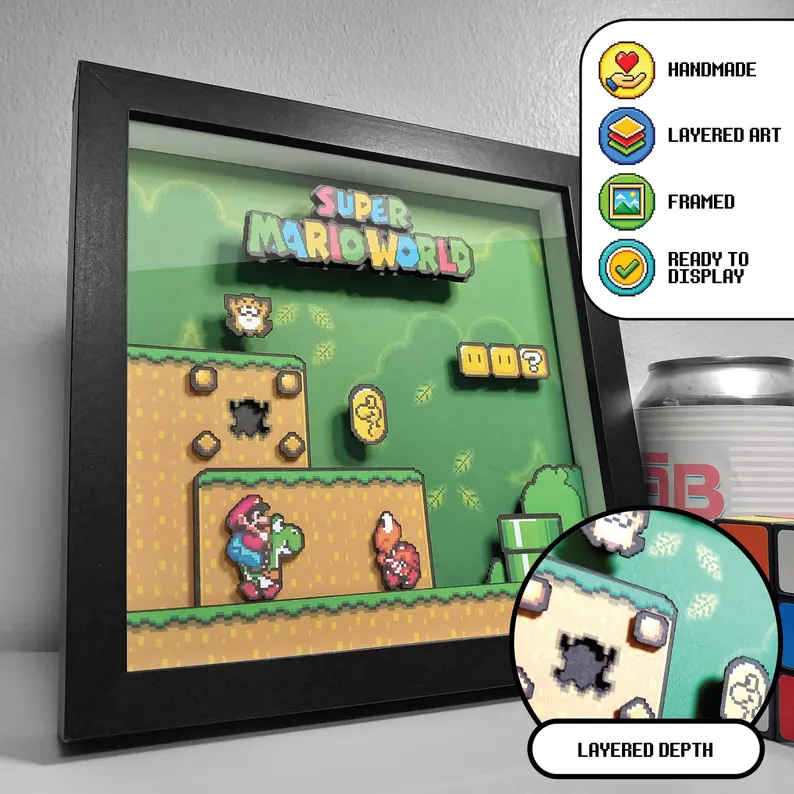
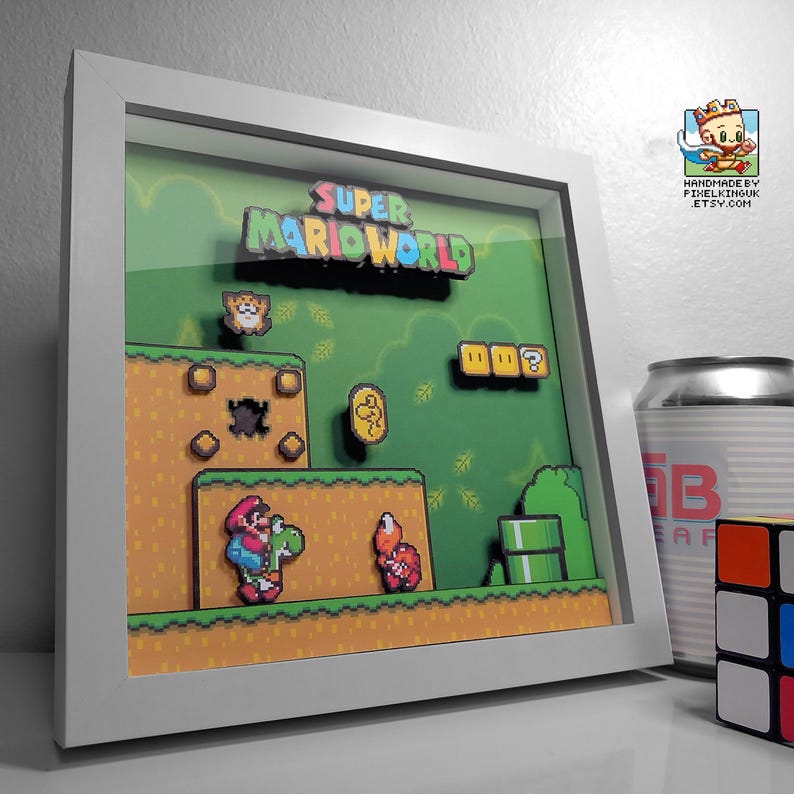
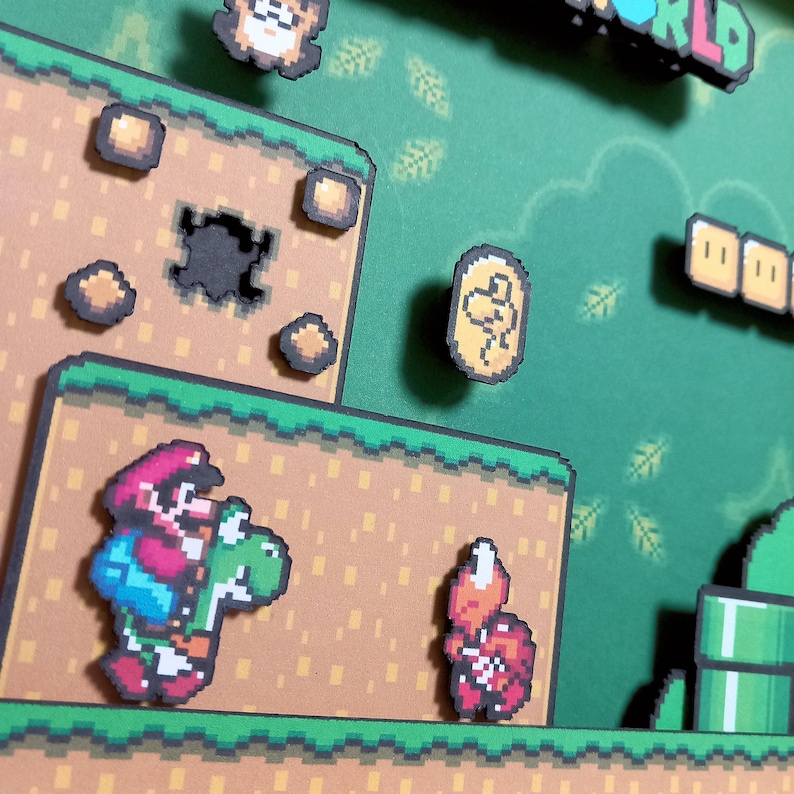
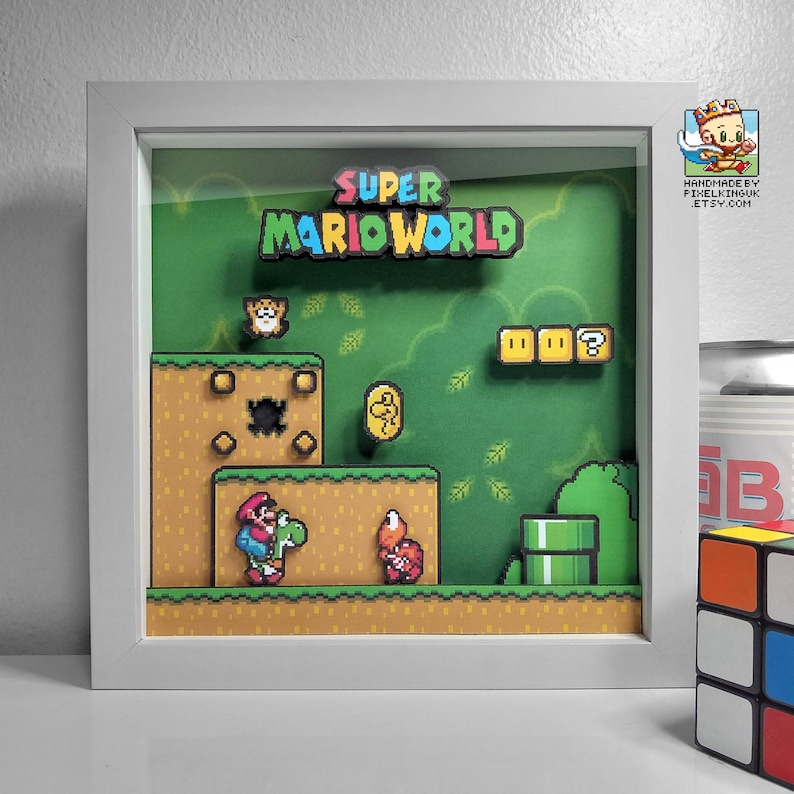
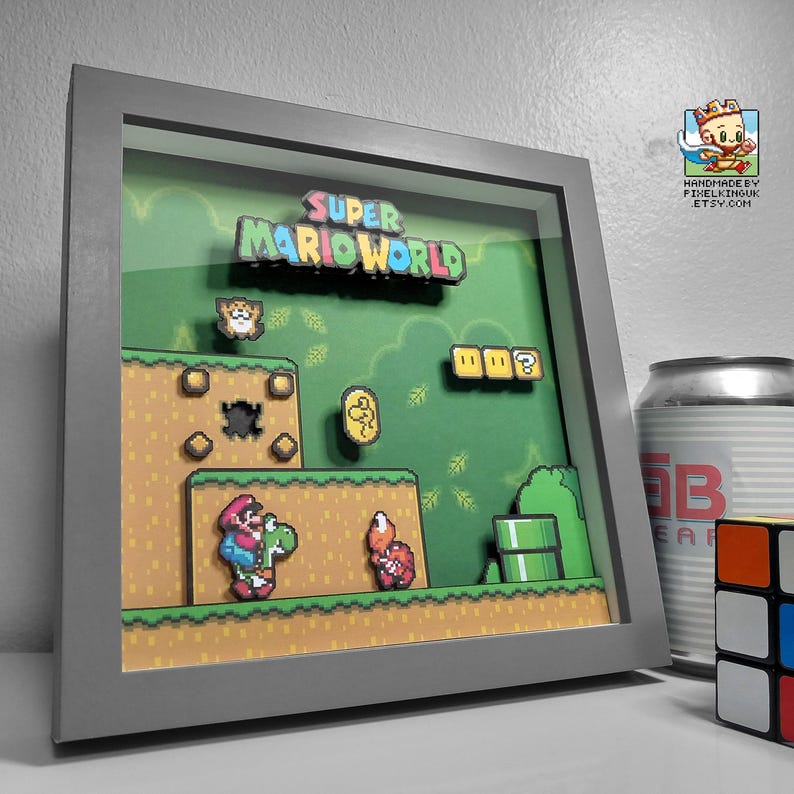
A Super Mario World pixel art shadow box turns a familiar 16-bit scene into a physical artwork with real depth. Instead of printing the whole screen on one flat sheet, selected characters, landscape elements and foreground details are separated into layers, cut individually and assembled inside a deep frame.
My current handmade design recreates a Yoshi’s Island stage with Yoshi, a red enemy, floating blocks and a green pipe. See the full build and current photographs in the Yoshi’s Island 2 Super Mario World shadow box feature.
What is a Super Mario World shadow box?
A shadow box is a display frame with enough space between the glass and backing board to hold a dimensional composition. For this piece, imagery inspired by the SNES game is divided into visual planes: sky and distant scenery at the back, terrain in the middle, then Mario, Yoshi and recognisable level details closer to the viewer.
The spacing creates changing shadows as the light and viewing angle move. That effect suits pixel art especially well because each sprite already has a crisp silhouette. The layers remain easy to read, while the scene gains a small theatrical quality that a flat poster cannot reproduce.
How the layered pixel art is made
1. Choosing a readable game scene
The strongest starting point is a composition with a clear foreground, middle distance and background. Important sprites should not overlap so heavily that their silhouettes disappear. Colour balance matters too: Mario and Yoshi need enough contrast to remain the focus once the image is divided.
2. Separating the visual planes
Each part of the screen is prepared as a separate layer. Distant hills and sky sit deepest in the frame; platforms and landscape details come forward; characters and selected foreground objects occupy the upper layers. Small gaps between them create the depth without distorting the original proportions.
3. Cutting, spacing and alignment
Clean edges are crucial because the stepped outline of pixel art exposes every inaccurate cut. The components are aligned against reference points in the scene, then fixed with consistent spacing. Before the frame is closed, the composition is checked from the front and from an angle to make sure no layer hides an important detail.
Why Super Mario World works so well as layered art
The game’s graphics have unusually strong visual hierarchy. Saturated character sprites sit against softer backgrounds, terrain has a definite edge, and decorative elements occupy clear planes. Its forests, hills, pipes and blocks are instantly recognisable without needing a caption. Those qualities make the artwork legible at the compact 8 × 8 inch scale of this frame.
Depth also reveals how carefully the original screen is composed. Once the scenery is physically separated, it becomes easier to see how distant shapes frame the playable route and how foreground objects guide attention towards the characters. For a fuller study of those choices, read why Super Mario World’s 16-bit pixel art still endures.
A retro gaming display with a clear focal point
The finished frame is designed for a shelf, desk or game-room wall. Its square format keeps the composition compact, while the bright SNES palette gives it presence among cartridges, consoles or other gaming artwork. It can work as a nostalgic gift, but it is also a way to appreciate game graphics as deliberate illustration rather than disposable screen imagery.
If you prefer a scene-specific breakdown, the companion feature explores the Yoshi’s Island 2 Super Mario World shadow box. You can browse the current handmade range in the PixelKingUK Etsy shop.
Super Mario World shadow-box questions
Is the artwork flat or genuinely layered?
It is assembled from separate cut elements inside a deep frame. The visible spacing and shadows create the three-dimensional effect.
What size is the frame?
This design uses a compact 8 × 8 inch frame. Check the current Etsy listing before ordering for the latest dimensions and availability.
Where can I find more handmade pixel art?
Explore the Pixel Art & Craft archive for more making stories, scene studies and layered gaming artwork.