See the Sonic Green Hill shadow box in motion
This short product video shows how the layered card scene creates real depth as the viewing angle changes.
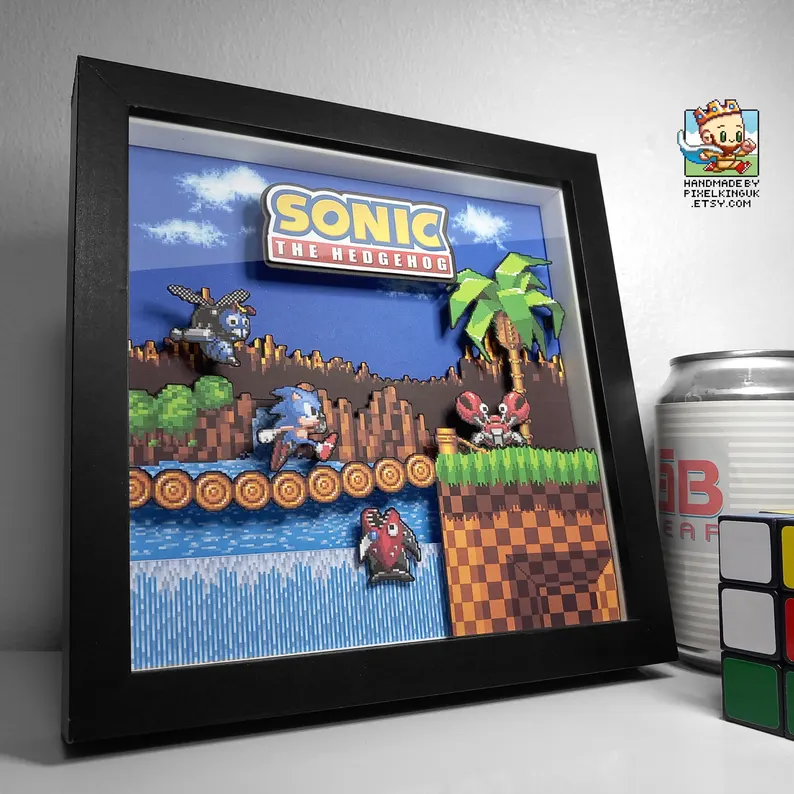
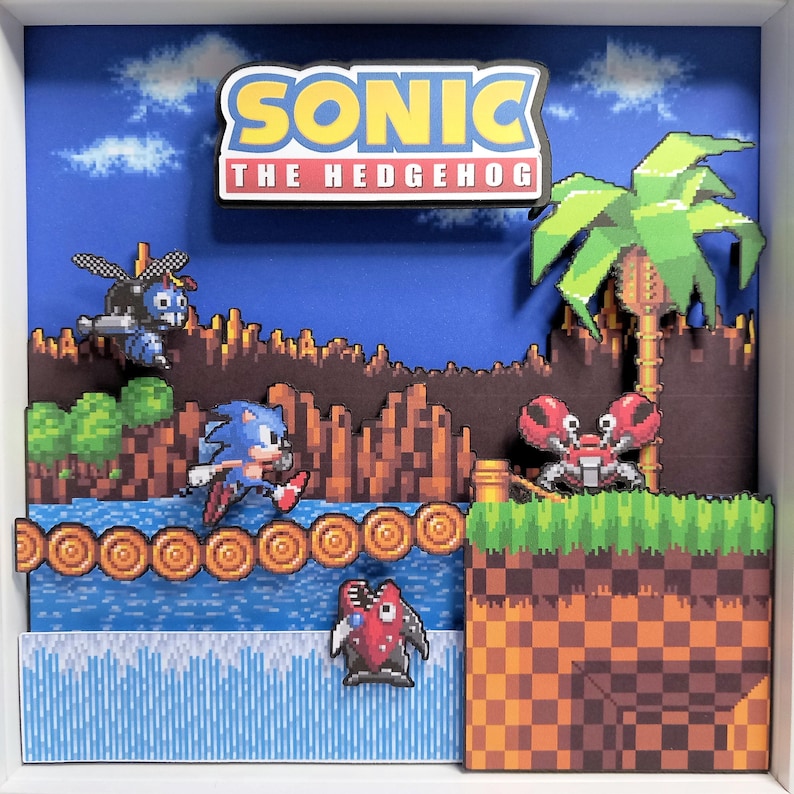
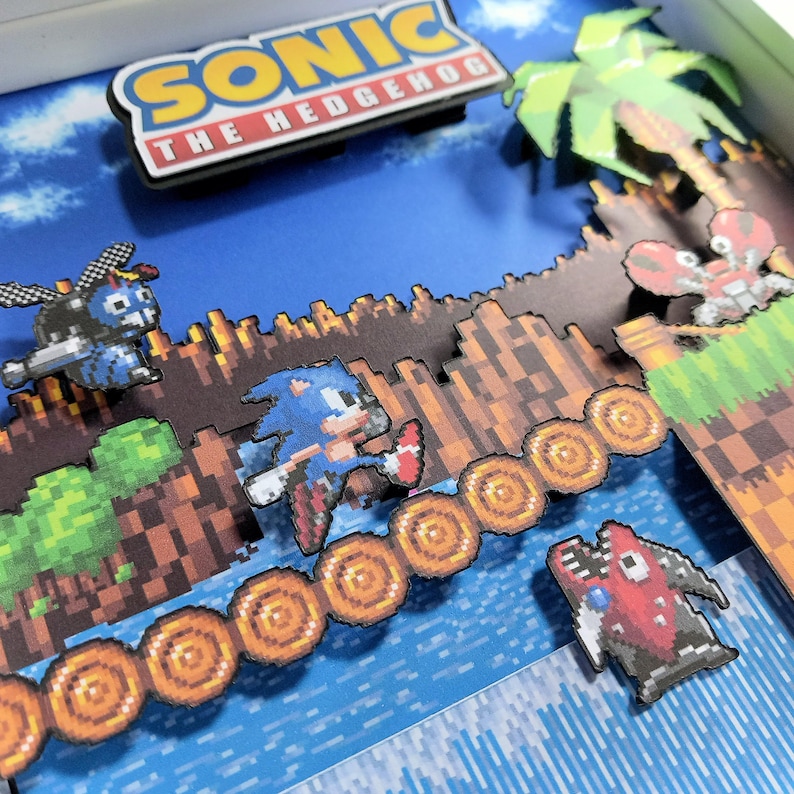
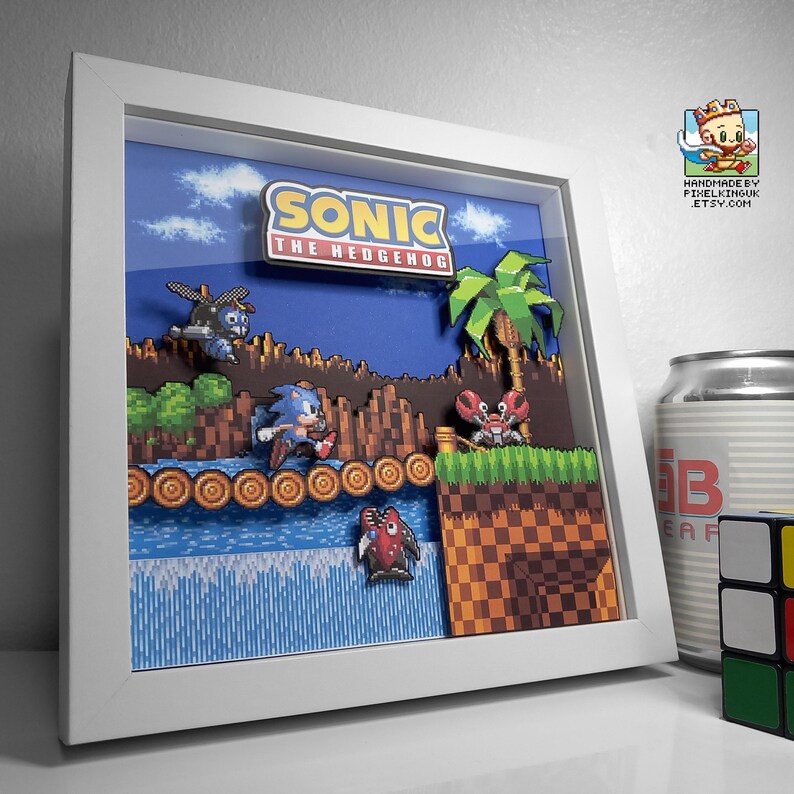
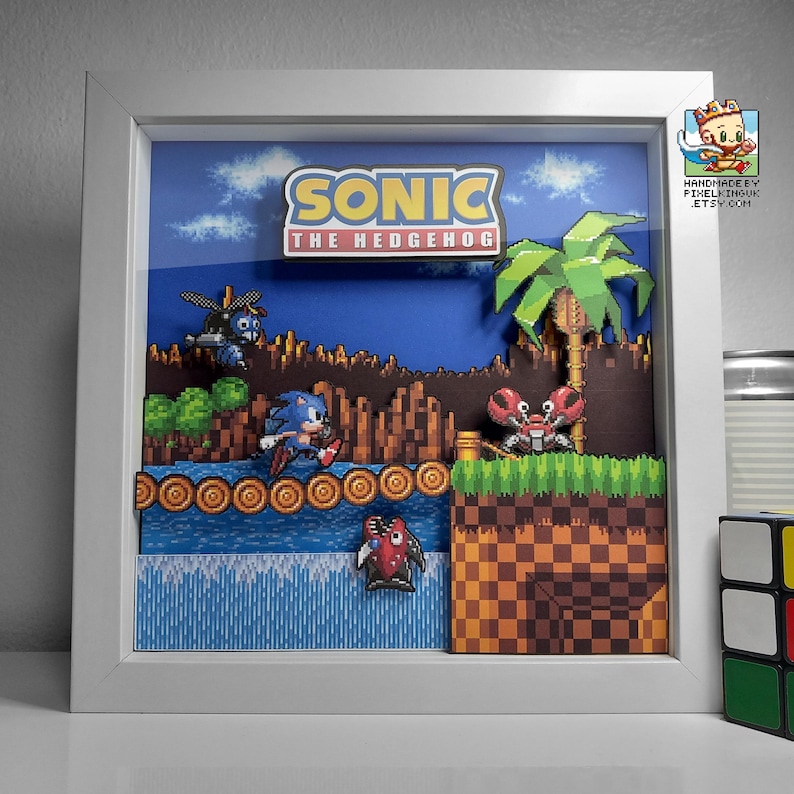
This Sonic the Hedgehog pixel art shadow box is inspired by the bold visual identity of Sonic’s first Mega Drive adventure: saturated colour, unmistakable character silhouettes and scenery designed to make speed readable. Separating the scene into physical layers gives the familiar 16-bit artwork real depth without losing its crisp pixel geometry.
Why the original Sonic pixel art is instantly recognisable
When Sonic the Hedgehog arrived in 1991, its art needed to establish a new Sega mascot at a glance. Sonic’s blue spikes, red shoes, peach muzzle and confident pose create a silhouette that works both standing still and curled into a spinning ball. The design is compact, but every colour block has a job.
The surrounding world is equally deliberate. Green Hill Zone combines checkerboard ground, curved palms, flowers, rings and blue water into a landscape that feels playful and fast. Those elements are decorative, but they also describe the route. Ramps and loops point forward, floating rings trace movement and sharp hazards interrupt the rhythm.
Colour and contrast keep Sonic at the centre
Sonic’s cobalt blue stands apart from the warm browns and vivid greens of the terrain. His red shoes add a small, high-energy accent close to the ground. Gold rings repeat across the level as bright markers, while skies and distant hills use broader, calmer areas of colour.
This hierarchy matters in a fast platform game: the player must distinguish Sonic, the route, collectibles and hazards almost instantly. It also makes the scene suitable for wall art. Even at a compact scale, the character remains the focal point rather than disappearing into background detail.
Turning a 16-bit Sonic scene into a shadow box
Selecting the visual planes
The scene is divided into distant background, level terrain, interactive details and character layers. A strong composition keeps Sonic free of heavy overlaps and uses the landscape to lead the eye towards him.
Preserving the pixel edges
Pixel art exposes inaccurate cutting more readily than a soft photographic edge. Each stepped outline must remain clean, especially around Sonic’s spikes, shoes, rings and fine pieces of scenery. Consistent alignment keeps the separate layers feeling like one original game screen.
Creating genuine depth
Spacers hold the cut planes apart inside the deep frame. Light falling into the gaps creates real shadows, so Sonic appears to stand in front of the terrain and the landscape recedes behind him. The effect changes with viewing angle rather than being simulated in a flat print.
The visual art of speed
The original game makes speed visible through curves, diagonals and repetition. Sonic’s running animation compresses his legs into a rapid circular form. Rings create dotted paths through the level. Palm trunks, platforms and patterned ground scroll past in strong horizontal bands. Even a still frame contains directional energy.
That makes this article distinct from the Sonic the Hedgehog 2 pixel art feature. The sequel page focuses on Sonic and Tails as a pair, busier zone design and the expanded visual language of the 1992 follow-up. This page is about the clarity of Sonic’s original identity and the Green Hill-era aesthetic that introduced it.
Displaying a handmade Sonic frame
The square format works on a desk, shelf or game-room wall, and the strong blue-green palette reads clearly from across a room. Up close, the cut outlines and spaces between layers reveal how the image is constructed. It can be a nostalgic gift for a Sega fan, but it also rewards anyone interested in sprite design and the graphic craft of early console games.
Sonic pixel-art shadow-box questions
Is this based on the first Sonic game?
The design draws on the visual language associated with Sonic’s original Mega Drive era. Refer to the current product photographs for the precise scene represented.
Is each frame handmade?
The scene is prepared as separate cut elements and assembled into a deep frame. Current specifications and ordering details are shown with each Etsy listing.
Browse current Sonic designs in the PixelKingUK Etsy shop and find more making features in Pixel Art & Craft.
For a more reflective scene from the sequel, see my Sonic 2 ending shadow box article.