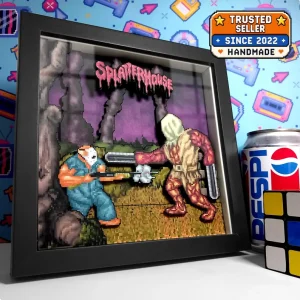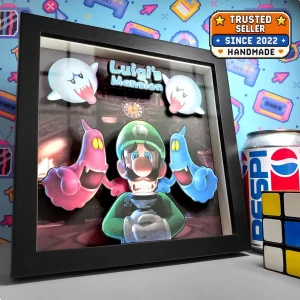
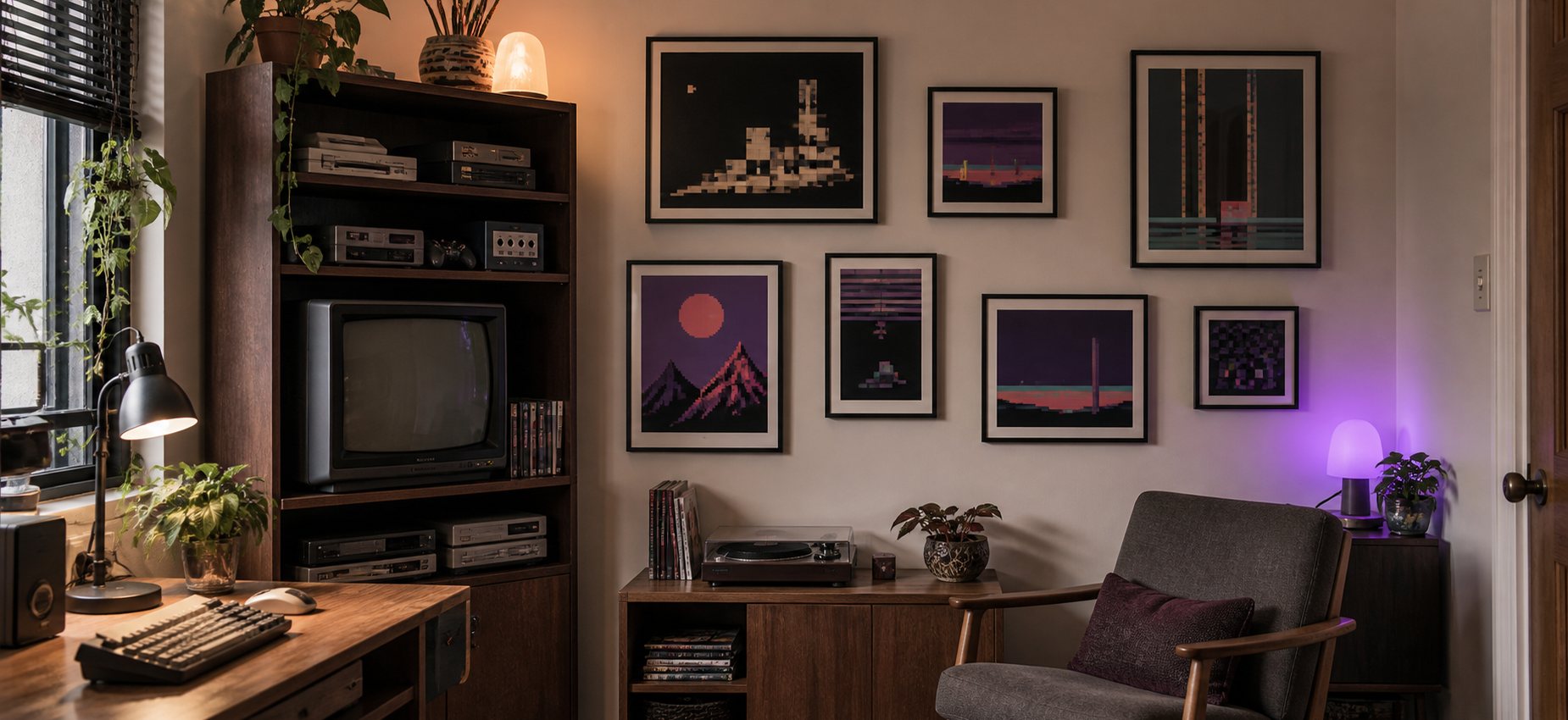
A grown-up games room does not have to hide the games you love. The trick is to treat gaming artwork as part of the room rather than adding it as an afterthought. Choose a clear visual direction, give each piece room to breathe and use lighting, framing and colour to connect everything together.
For a recognisable arcade-era focal point, my Space Invaders pixel-art shadow box article shows how a tiny set of blocky shapes can carry a surprising amount of visual character.
I make layered gaming shadow boxes, so I spend a lot of time thinking about how familiar game scenes work away from a screen. The best displays are rarely the busiest. They are the ones where a visitor notices a strong piece of art first, then gradually recognises the game, character or memory behind it.
1. Choose one visual direction before buying anything
“Gaming” is too broad to be a useful decorating style. An arcade cabinet, a quiet Japanese role-playing game and a futuristic racing game can all look completely different. Start with the feeling you want the room to have.
- 16-bit nostalgia: warm greys, restrained purple or raspberry accents, framed pixel art and a few original cartridges.
- Arcade energy: darker walls, bolder artwork, strong primary colours and focused pools of light.
- Retro-futurist: charcoal, smoked glass, violet lighting, metallic details and clean geometric game art.
- Collected studio: neutral walls, wooden shelves, art books, plants and carefully framed pieces from several eras.
You do not need every object to match. Repeating two or three colours is normally enough to make different consoles and franchises feel intentional.
2. Start with one anchor piece
Choose the artwork you most want people to notice and build outwards from it. That might be a large framed print above a desk, a dimensional shadow box beside a record shelf or a triptych on the longest wall.
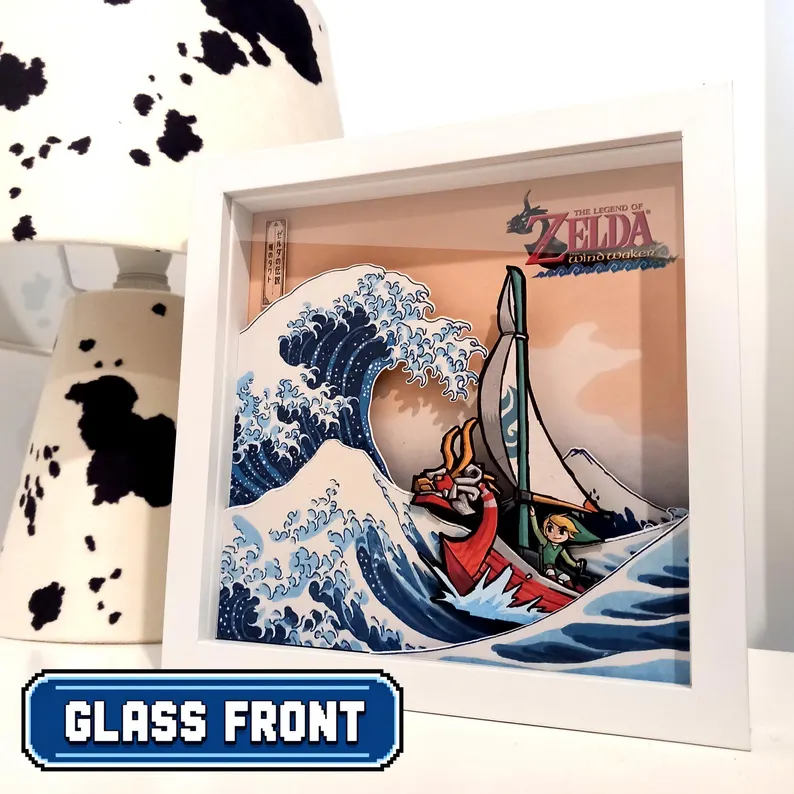
Dimensional art works particularly well as an anchor because it changes with the light. In my own Wind Waker layered artwork, the physical spacing separates the wave, boat and characters in a way a flat poster cannot. The effect is still subtle enough to live in a home office or sitting room.
3. Get the scale and spacing right
Gaming art often looks smaller once it is on a wall. Before ordering, mark the proposed dimensions with low-tack masking tape and step back to the position from which you normally enter the room.
| Display position | Useful approach | Check before hanging |
|---|---|---|
| Above a desk | One medium landscape piece or two aligned frames | Allow space above monitors and avoid screen glare |
| Above a sofa | A large anchor piece or compact three-piece group | Aim for roughly two-thirds of the furniture width |
| Beside shelving | One square or portrait artwork at eye level | Align it with a shelf edge or repeated horizontal line |
| Gallery wall | Mix sizes but repeat frame colour or mount spacing | Lay the complete arrangement on the floor first |
| Small corner | One detailed piece with a narrow picture light | Keep the artwork clear of doors and chair movement |
For a group of frames, 5–8 cm between pieces usually reads as one arrangement without making them feel cramped. Aligning the centres can look more relaxed; aligning top or bottom edges produces a tidier console-panel rhythm.
4. Pick a display style that suits the room
A single framed game scene
This is the safest option for a shared living space or home office. Choose a scene with a clear silhouette and a palette that already appears elsewhere in the room. A single scene also gives pixel art enough distance to read properly.
A restrained gallery wall
Mix game art with adjacent interests: soundtrack sleeves, animation sketches, old magazine covers or small pieces of abstract art. This keeps the display personal and avoids making it feel like a merchandise catalogue.
Artwork mixed with physical objects
A cartridge, controller or boxed game can add context, but it should not compete with the artwork. Use shallow shelves and repeat the frame colour in the shelf brackets or display stands.
A chronological wall
For collectors, arrange pieces by console generation or by the games that mattered at different points in your life. It turns the wall into a personal timeline rather than a random group of recognisable characters.
5. Light the artwork, not the whole wall
Strong RGB strips can flatten everything into one colour. Use ambient lighting for atmosphere, then a separate warm picture light or angled lamp for the art. If the piece is behind glass, move the light source sideways rather than pointing it directly at the frame.
- Use warm-white light for paper, cardstock and printed artwork.
- Keep coloured accent lights outside the frame’s main viewing angle.
- Avoid direct sunlight, which can fade paper and create uncomfortable glare.
- For layered pieces, side lighting reveals depth more clearly than flat frontal light.
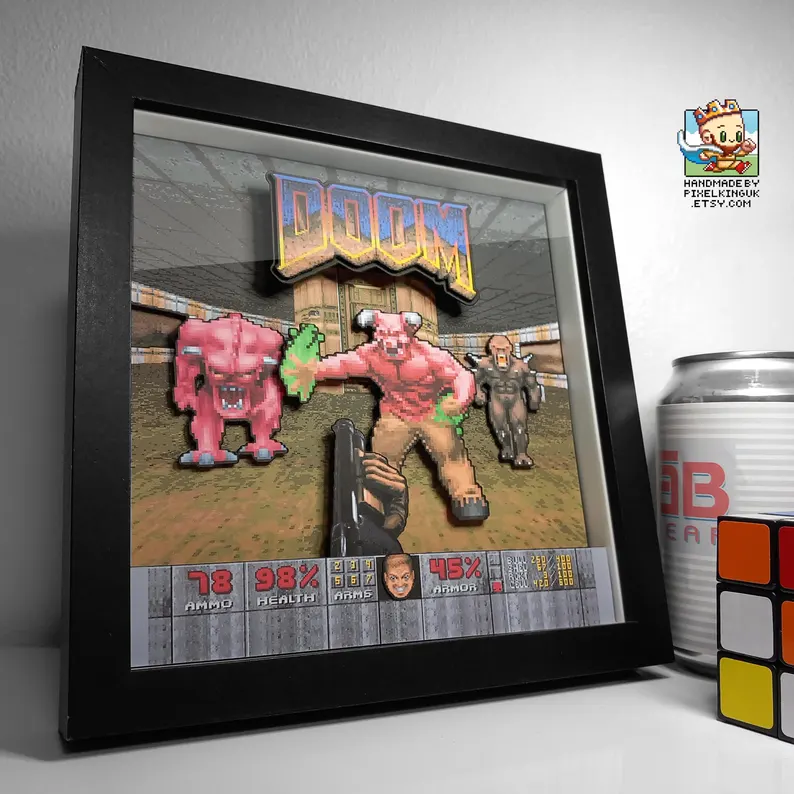
The depth in a layered Doom shadow box, for example, becomes more noticeable when gentle light catches the spaces between foreground and background.
6. Make a small gaming space feel deliberate
You do not need a dedicated room. A home-office wall, an alcove or the area above a compact console unit can carry the same idea. In a small space, choose fewer objects and let practical items join the composition.
A desk lamp can echo the colour of a frame. A closed storage unit can hide cables and spare controllers. One plant or wooden shelf softens the harder lines of screens and electronics. The contrast helps pixel art feel like artwork rather than another illuminated display.
7. Avoid the common games-room mistakes
- Buying many small items before choosing a focal point. Start with the wall, then add objects that support it.
- Using every franchise colour at once. Let the room provide a neutral base and repeat only a few accent colours.
- Hanging artwork too high. Eye level when seated may matter more than standing gallery height in a games room.
- Ignoring reflections. Check the frame from the chair and doorway before fixing the final position.
- Treating nostalgia as clutter. The memories matter more when each object has enough space to be seen.
How handmade layered gaming art fits into the room
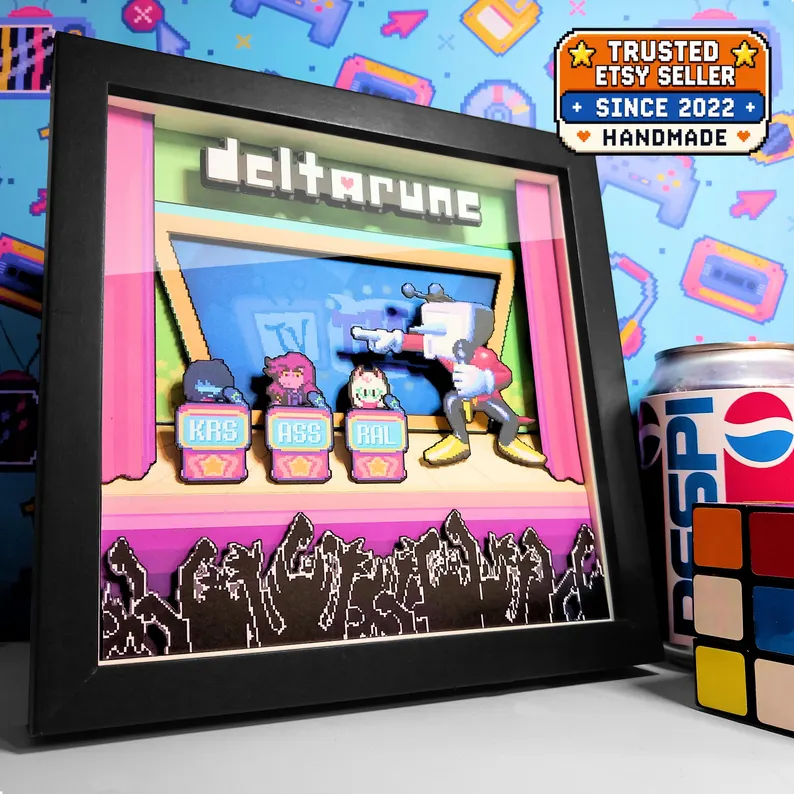
I build my shadow boxes by separating a game scene into individual cardstock layers, cutting each element and spacing the layers inside a wooden frame. The aim is not to make pixel art smoother or more realistic. It is to preserve its hard edges while turning the original depth cues into real physical depth.
That makes them useful when you want gaming wall art with more presence than a print but less visual noise than a bright sign. Frame colours and sizes can be chosen to suit the available wall rather than forcing the whole room around one object.
VIEW MY HANDMADE GAMING ART ON ETSY
Questions people ask about gaming wall art
Can gaming art work in a living room?
Yes. Choose one well-made piece with a palette that relates to the room, then frame and light it in the same way you would any other artwork. Subtle game references often work better than a wall full of logos.
Should all the frames match?
They do not have to be identical, but repeating one feature—colour, material, mount width or corner shape—helps a mixed collection feel connected.
Are posters or dimensional pieces better?
Posters are excellent for large areas and changing displays. Dimensional pieces suit focal points where craftsmanship, shadow and texture can be appreciated. Combining one dimensional anchor with quieter flat prints gives useful contrast.
How do I choose artwork as a gift?
Start with the exact game or era they return to, then check their wall space and existing frame colours. My guide to gifts for retro gamers includes a practical chooser for different kinds of player and collector.
Continue exploring
For more detail on the craft itself, explore the site’s pixel art and craft articles. You can also discover why Super Mario World’s pixel art still reads so clearly decades after the original hardware.