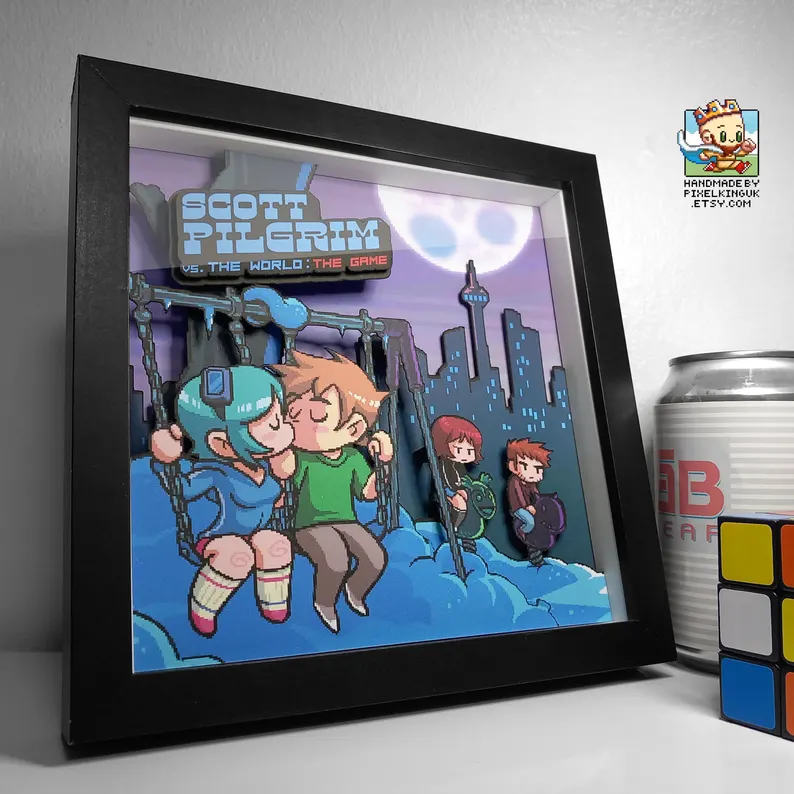
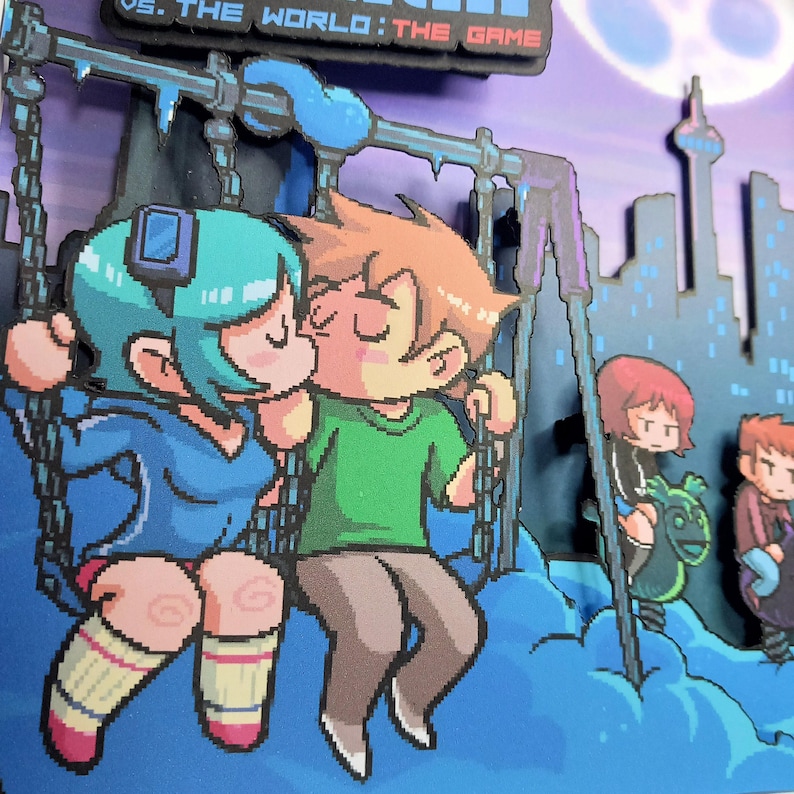
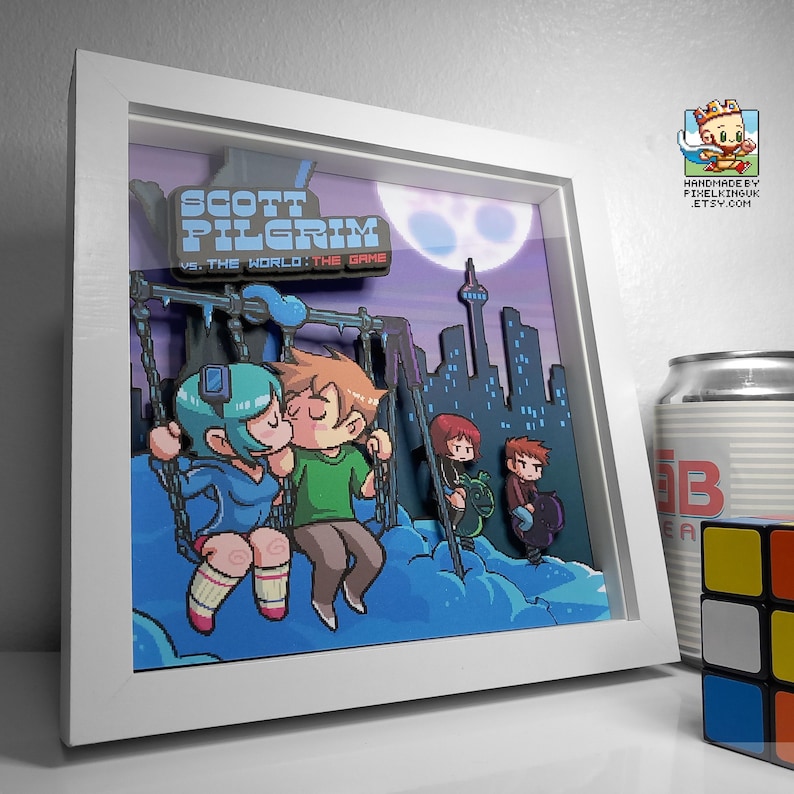
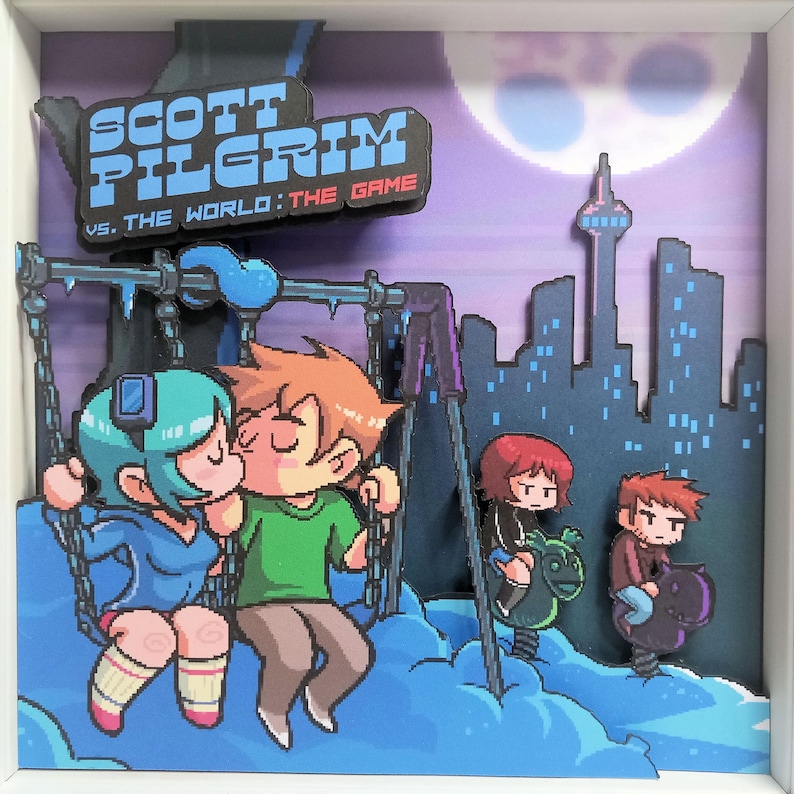
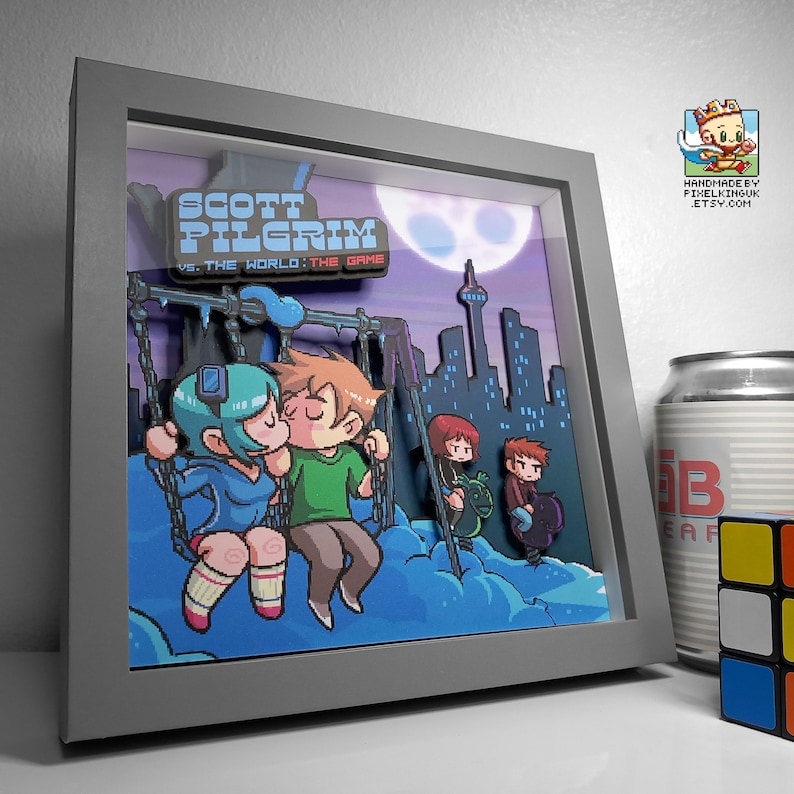
A Scott Pilgrim pixel art shadow box brings the energetic, game-inspired world of Scott Pilgrim vs. the World: The Game into physical layers. Character sprites, Toronto scenery and arcade-style effects are separated inside a deep frame, preserving the artwork’s bold outlines while creating real depth.
Why Scott Pilgrim works so naturally in pixel art
Scott Pilgrim has always mixed comics, music and video-game language. The 2010 beat ’em up turns that mixture into a playable world: characters move like exaggerated arcade fighters, defeated enemies burst into coins, and familiar city locations become colourful side-scrolling stages.
Pixel art is more than a nostalgic filter here. It connects the game to the mechanics and visual shorthand referenced throughout Bryan Lee O’Malley’s graphic novels. Health, money, upgrades and combat effects can sit visibly alongside the story without feeling imported from another style.
Character sprites full of personality
Scott, Ramona, Kim, Stephen and the wider cast are recognised through silhouette, hair, clothing colour and exaggerated pose. Their sprites are compact but highly expressive. A few animation frames communicate confidence, awkwardness, anger or exhaustion, which keeps the characters connected to their comic counterparts.
Combat stretches that expression further. Wind-up poses, impact frames and comic visual effects make each attack easy to read. The animation can be funny and forceful at once, matching a story in which emotional conflict is routinely transformed into an arcade battle.
Toronto as a colourful game world
The backgrounds reinterpret streets, shops, clubs and wintry city spaces with dense but controlled detail. Signs, windows, crowds and small jokes reward a closer look, while the playable route stays clear. Saturated foreground characters stand against broader blocks of environmental colour.
This layering of real place and imaginary game space makes a scene especially suitable for display. Even viewers who do not identify every reference can follow the composition through its strong colour and rhythm.
How the Scott Pilgrim shadow box is constructed
The source scene is divided into background architecture, middle-distance street or stage elements, character sprites and foreground effects. Each element is cut along its pixel outline and positioned on a separate plane. Consistent spacers preserve alignment and create genuine shadows.
Characters are kept nearest the glass so their poses remain the focus. Environmental detail sits deeper in the frame, where it provides context without overwhelming the cast. Viewed from the front, the layers combine into one scene; from an angle, the spaces between them become part of the artwork.
Choosing the right frame presentation
A white frame gives the bright palette a clean, comic-page border. Black increases contrast and can suit a darker gaming setup, while grey offers a quieter middle ground. The photographs show how the same art changes character with each finish.
A meeting point for comics and game art
The finished piece is not only merchandise tied to a familiar character. It highlights a visual style designed specifically to bridge media: comic expression, arcade timing, music-culture energy and pixel craftsmanship. That makes it a strong companion to other modern games that chose pixels deliberately rather than through hardware necessity.
For more modern pixel-art games translated into physical layers, see the Cave Story pixel art shadow box and my new Deltarune Chapter 3 TV Time shadow box. More handmade scene studies appear in Pixel Art & Craft.
Scott Pilgrim shadow-box questions
Is the layered effect real?
Yes. The composition uses separately cut and spaced visual planes rather than a printed imitation of depth.
Where can I check availability?
Browse current designs, frame choices and ordering details in the PixelKingUK Etsy shop.