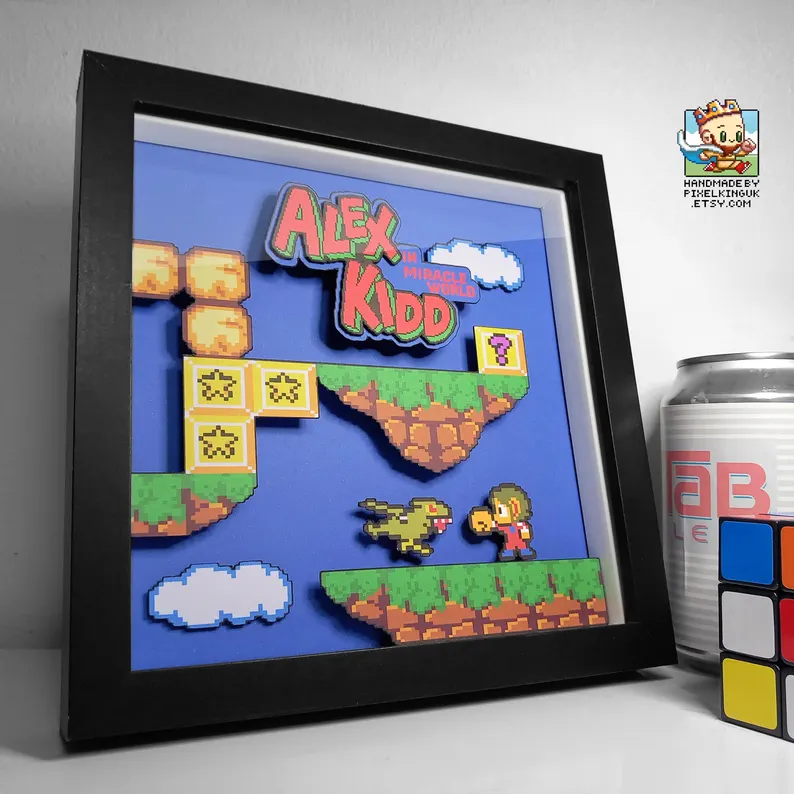
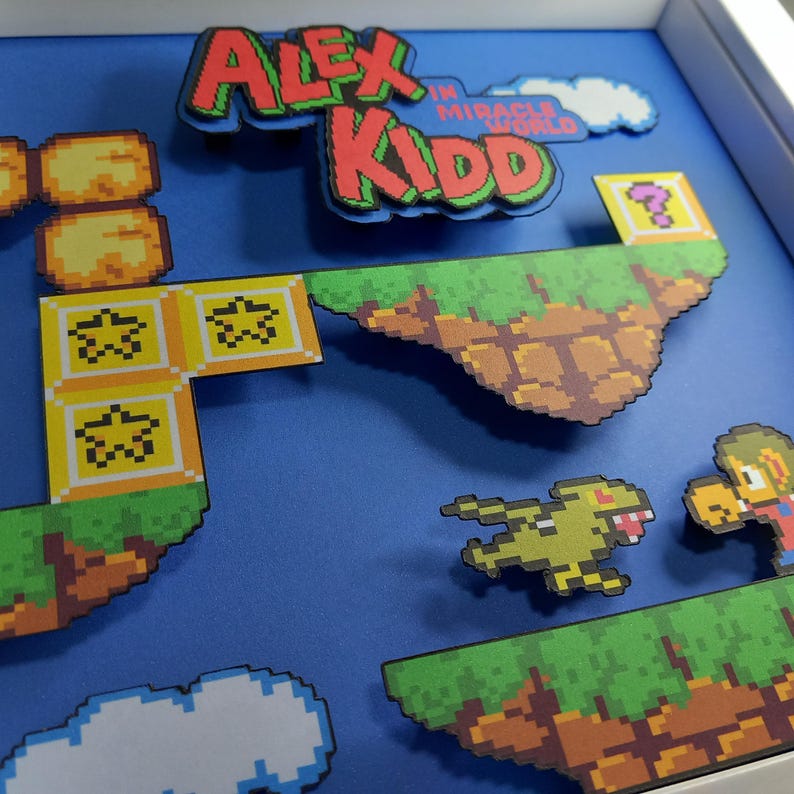
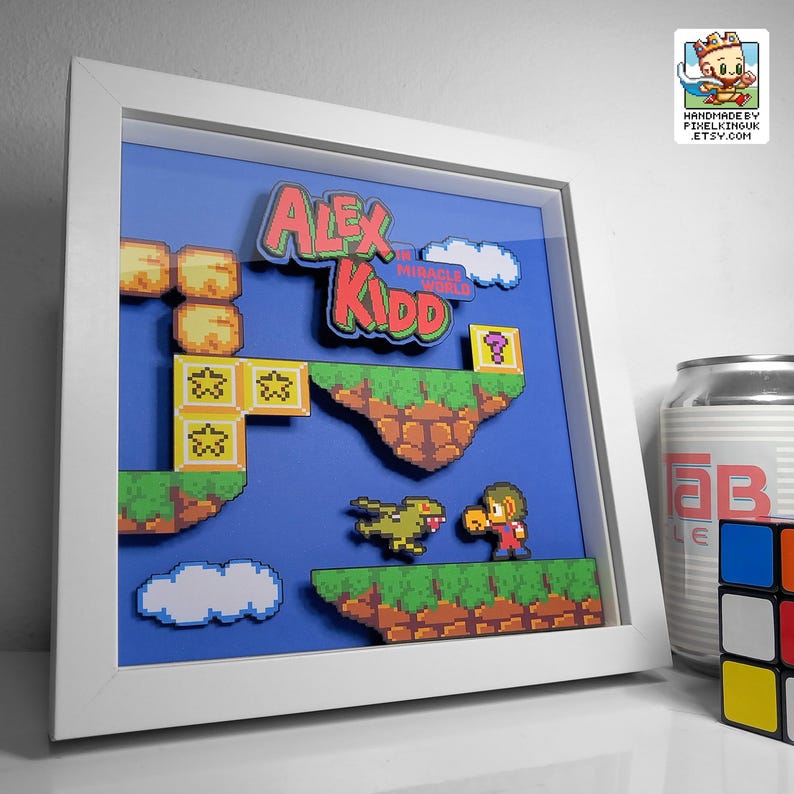
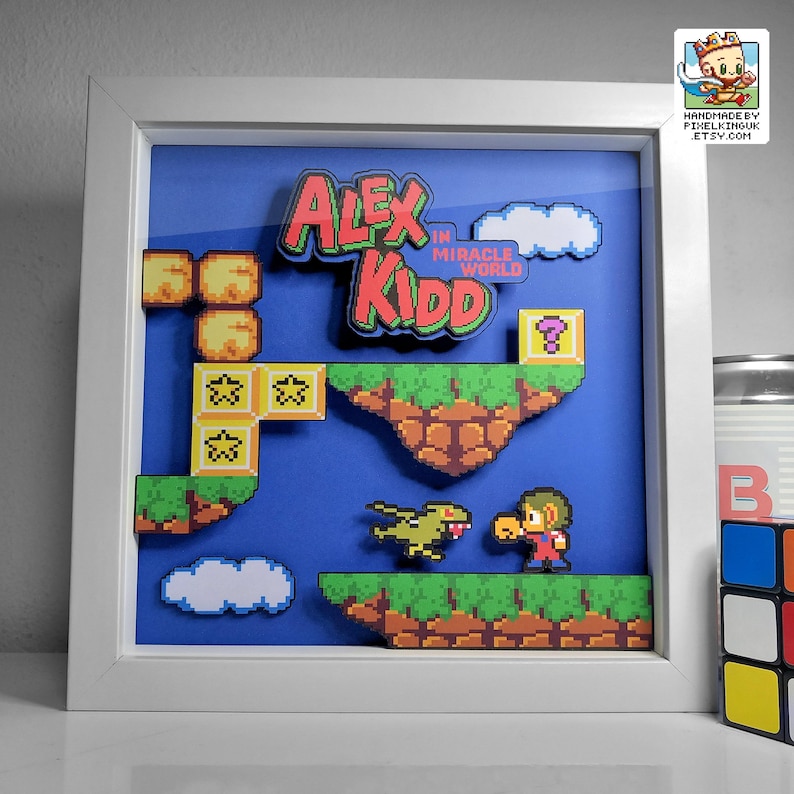
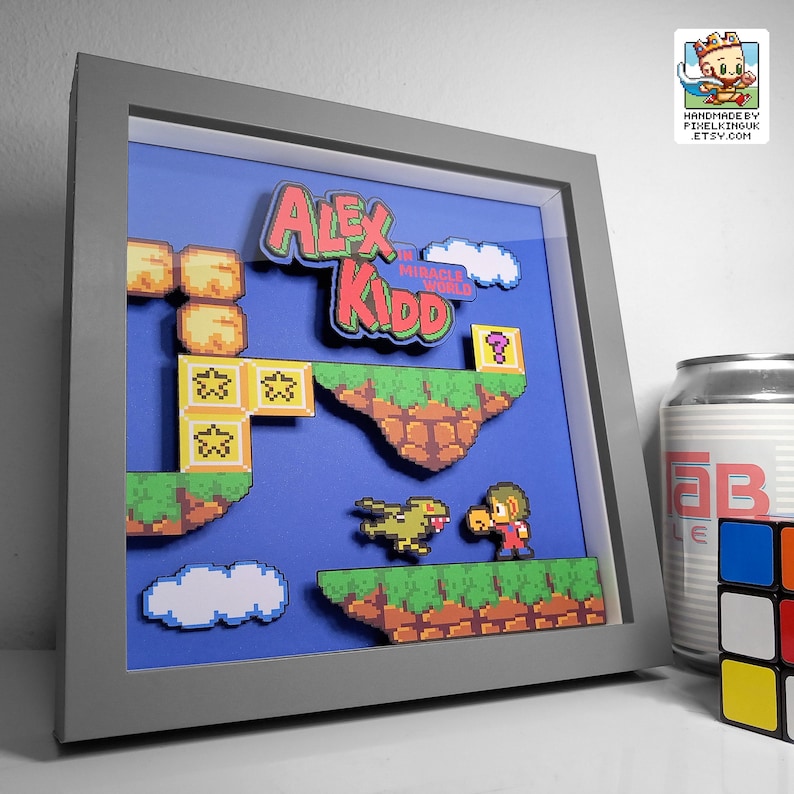
An Alex Kidd in Miracle World pixel art shadow box celebrates one of the Sega Master System’s most recognisable adventures. Alex, the blocky landscape and colourful enemies are separated into physical layers, giving the compact 8-bit scene depth while retaining the direct visual language of the original game.
Why Alex Kidd in Miracle World is remembered
Released in 1986, Alex Kidd in Miracle World follows Alex through the kingdom of Radaxian as he fights enemies, rides vehicles and faces opponents in games of rock-paper-scissors. For many Master System owners, it became especially familiar because versions of the console included the game in the hardware.
That accessibility helped Alex become an early Sega mascot, but the game’s variety gave it staying power. Platforming stages shift between walking, swimming and vehicle sections, while shops and Janken encounters interrupt the rhythm with different visual and mechanical ideas.
How 8-bit art defines Miracle World
The Master System artwork uses large, readable colour areas rather than fine texture. Alex’s oversized ears, dark hair, red clothing and strong punching pose make him recognisable in a small sprite. Enemies are equally direct, with clear silhouettes and simple animation that reveal how they move.
Environments change through palette and tile design. Stone blocks, grass, water, caves and castles establish each area with a limited set of repeating elements. The best screens feel varied without becoming confusing because playable surfaces keep a clear edge against the background.
The visual charm of Alex’s oversized punch
Alex’s punch is both a game mechanic and a character-defining image. His arm projects forward in an exaggerated pose that reads instantly, whether he is striking an enemy or breaking a block. The animation gives a small sprite unusual confidence and provides a natural focal pose for framed art.
The contrast between the cheerful hero and surprisingly demanding hazards is part of the game’s personality. Bright colours invite the player forward, while sudden enemies, fragile blocks and boss encounters make the world less gentle than it first appears.
Creating the layered Alex Kidd scene
The composition is divided into sky or distant scenery, level architecture, interactive blocks, characters and foreground details. Alex sits on an upper layer so his sprite remains clear, while the terrain and decorative tiles recede behind him.
Each piece is cut along its stepped pixel outline. Consistent spacers hold the planes apart and create genuine shadows within the deep frame. Because 8-bit graphics use especially bold edges, precise alignment is essential: a misplaced block or uneven baseline is immediately noticeable.
Why Master System pixel art works as decor
The artwork remains clear from a distance because it was designed to be understood on modest 1980s displays. Up close, the physical layers reveal how repeated tiles and a few character colours can produce an entire world. The frame therefore works as nostalgic Sega decor and as a small study in economical game illustration.
Fans of Sega’s later mascot can compare this restrained 8-bit language with the brighter, faster Sonic the Hedgehog pixel art shadow box. More handmade features are collected in Pixel Art & Craft.
Alex Kidd shadow-box questions
Is the artwork based on the Master System game?
Yes. The scene draws on the 8-bit visual style of Alex Kidd in Miracle World. Check the listing photographs for the exact composition.
How is the depth produced?
The scene elements are separately cut and spaced inside a deep frame. The shadows between them are physical rather than printed.
See current options and availability on the Alex Kidd pixel art Etsy listing.