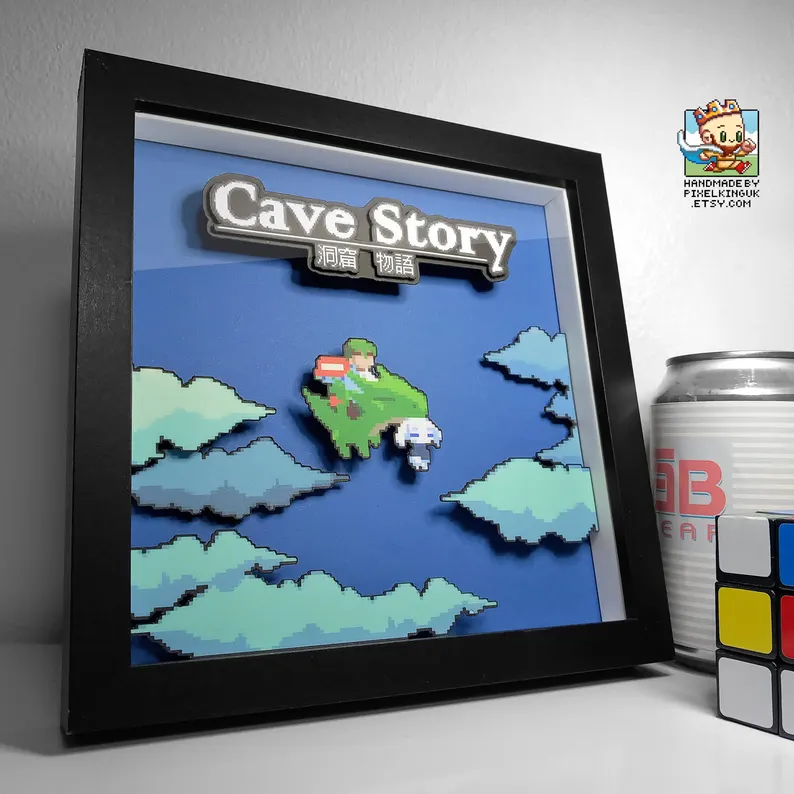
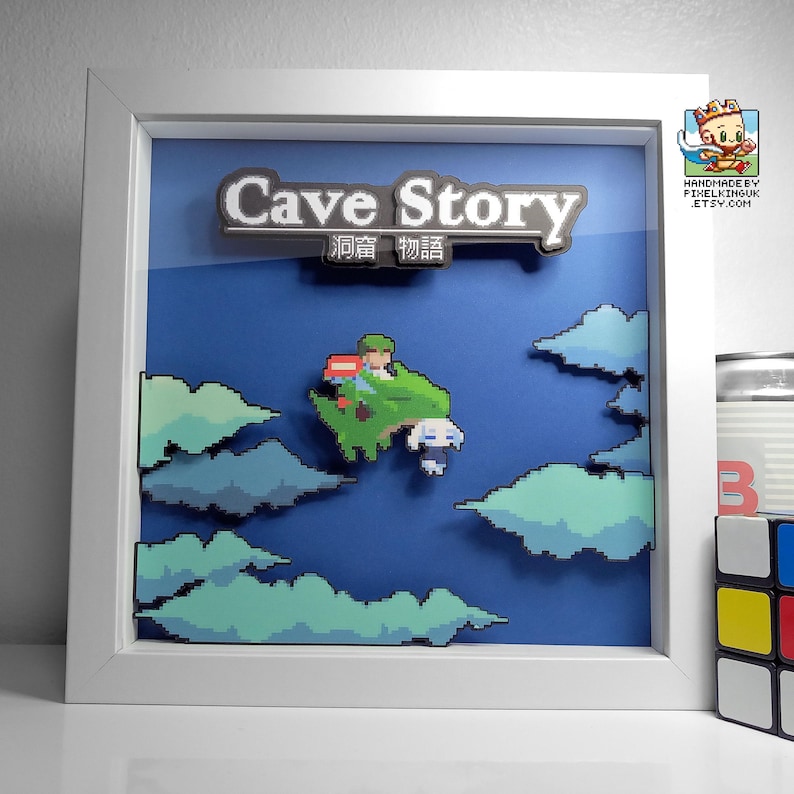
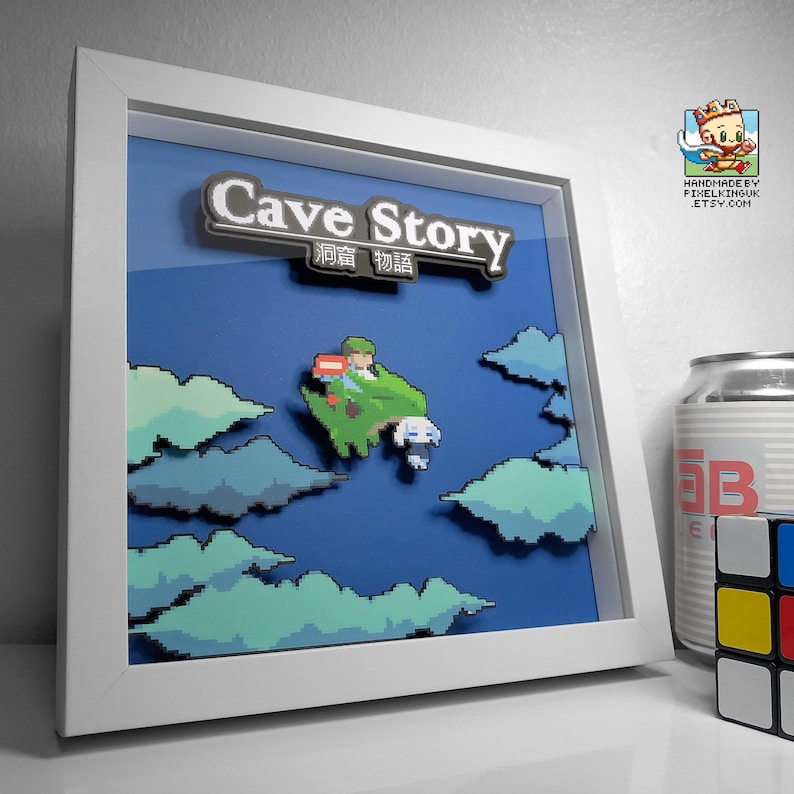
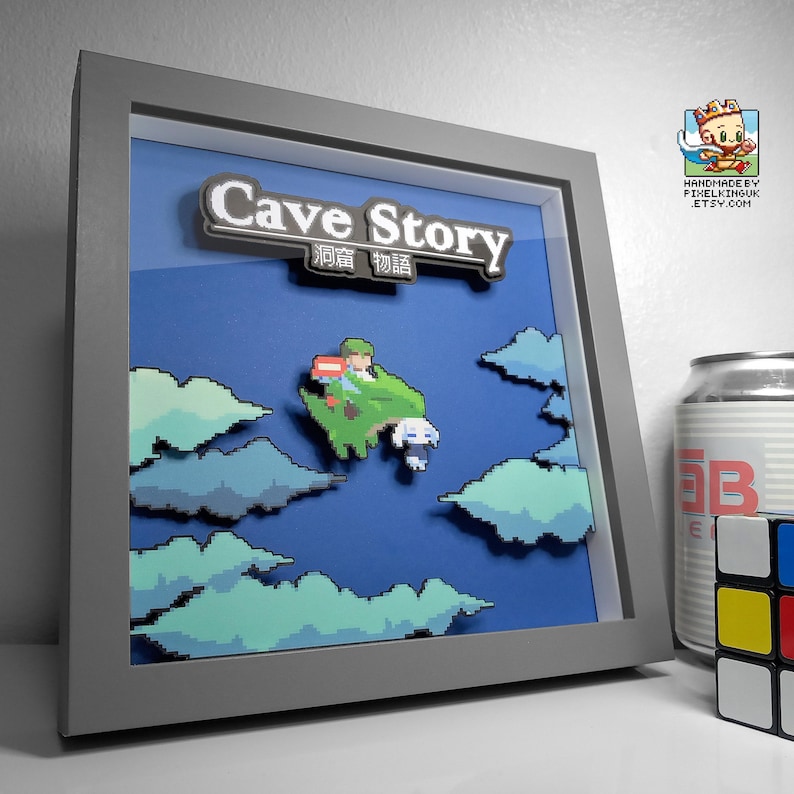
A Cave Story pixel art shadow box suits a game whose visual identity was created through careful restraint. Compact sprites, limited palettes and readable cave environments give the artwork clarity at a small scale, while physical spacing adds depth to the floating island and underground spaces explored by Quote.
Why Cave Story’s pixel art matters
Originally released as freeware in 2004, Cave Story was largely created by Daisuke “Pixel” Amaya over several years. Its independent origins became part of its reputation, but the game endures because its art, music, movement and storytelling feel deliberately unified rather than merely small in scale.
The sprites avoid unnecessary detail. Quote is recognised by his pale face, red cap and compact body; Mimigas use large ears and simple expressions; enemies are built around strong silhouettes. That economy lets emotion survive even when a character occupies only a small area of the screen.
Caves that remain clear and atmospheric
Underground settings can easily become a wall of brown or grey. Cave Story separates paths, platforms, hazards and decoration with controlled contrast. Repeated rock tiles describe the environment, while water, plants, machinery and architecture give each region a different identity.
Backgrounds are detailed enough to suggest history but quiet enough for action. The player can identify safe ground, doors and enemies without losing the feeling of exploring an old, mysterious place. That balance between atmosphere and readability is one of the game’s strongest visual achievements.
How the Cave Story scene becomes layered art
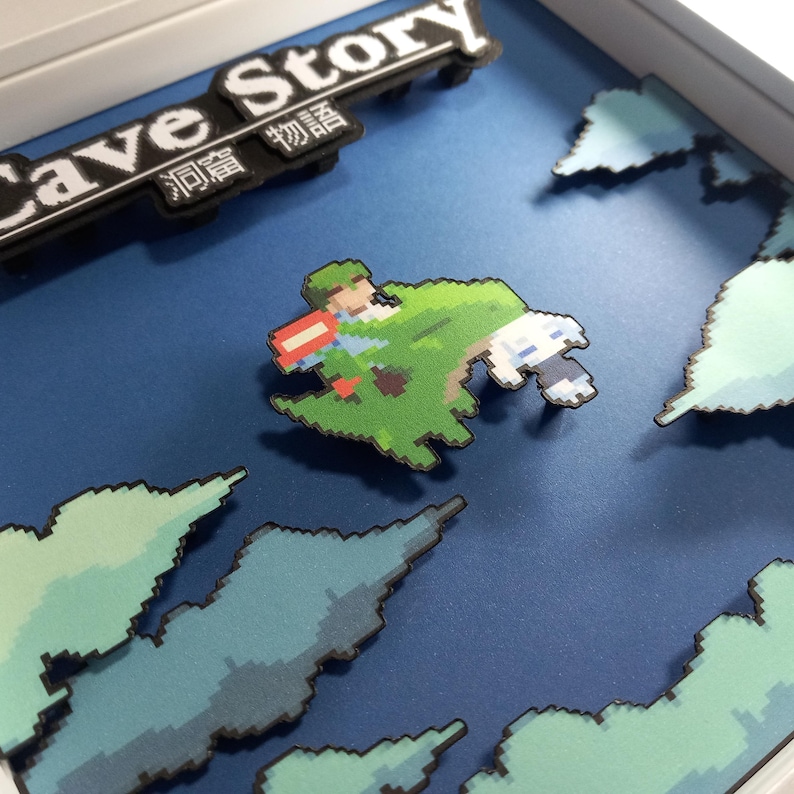
The scene is separated into a deep environmental backing, middle-distance platforms and architecture, then character and foreground layers. Quote and other important sprites sit forward so their small silhouettes do not merge with the cave textures behind them.
Each piece is cut along the stepped pixel edge and aligned to the original composition. Spacers create a consistent gap between planes, producing real shadows around platforms, characters and openings. The depth becomes more visible from an angle while the front view still resembles a coherent game screen.
What makes a good Cave Story shadow-box composition?
- A recognisable focal character: Quote or another principal sprite needs clear space around the silhouette.
- Distinct environmental planes: rear cave walls, playable terrain and foreground detail should separate naturally.
- Controlled colour: brighter character and interface colours must remain visible against stone textures.
- Purposeful detail: doors, plants or machinery can identify the location without crowding the frame.
A tribute to independent game art
Cave Story is often discussed as an influential independent game, and its artwork explains part of that influence. It demonstrates that a small production can develop a complete visual world through consistency and strong choices. The pixels do not imitate a larger budget; they form an aesthetic with its own warmth and precision.
The finished frame works as nostalgic game-room decor, but it is also a small celebration of solo game-making and sprite craft. For more modern indie-game pixel art, see how I turned Deltarune Chapter 3’s TV Time scene into a layered shadow box. You can also explore the Scott Pilgrim pixel art shadow box or browse the full Pixel Art & Craft archive.
Cave Story shadow-box questions
Is the depth created digitally?
No. The scene is assembled from separately cut artwork positioned on physical planes inside a deep frame.
Where can I check the current design?
See photographs, current specifications and availability on the Cave Story shadow box Etsy listing.